At Netdevices, when it comes to developing a mobile application, the choice of technology is essential to ensure performance, an optimal user experience, and controlled costs. React Native, a framework developed by Facebook, has quickly established itself as an essential solution in the field of mobile and cross-platform development.
At NetDevices, we are experts in developing native and hybrid mobile applications. As an agency specializing in React Native with solid experience, in this article we explain why this technology is ideal for building your mobile application.
What is React Native?
React Native is an open-source framework created by Facebook (Meta) that allows developers to build native mobile applications for iOS and Android from a single JavaScript code base.
Instead of creating two separate applications in Swift/Objective-C for iOS and Java/Kotlin for Android, React Native uses a common code base, which simplifies the development process while ensuring a user experience close to that of a native application.
Using React Native
React Native is widely adopted in the technology sector, used for applications ranging from social media to financial services. Notable examples include:
- Instagram: Performance improvements and simplification of the code base.
- Airbnb: Successful migration to React Native with significant savings in development time.
- Uber Eats: Providing an intuitive user experience across all platforms.
- Skype: Transition to React Native for a smoother and more consistent user experience.
Origins of React Native
React Native was created by Facebook (Meta) in 2015 with the aim of simplifying and accelerating mobile application development.
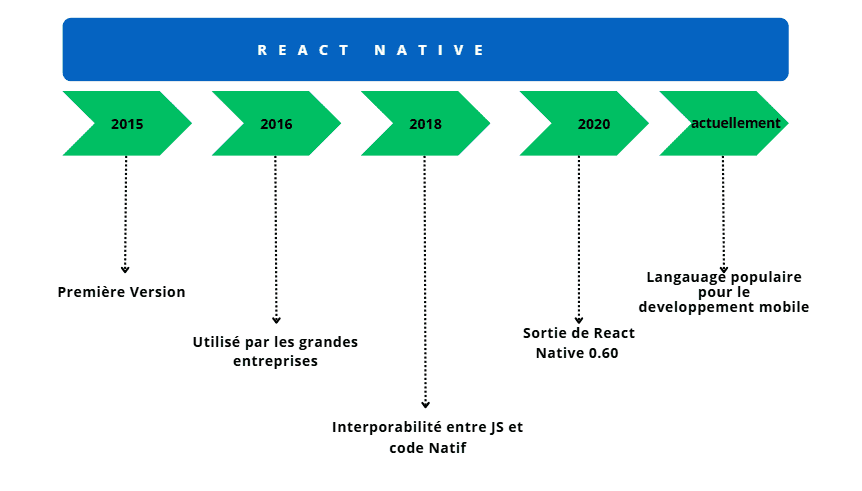
The project stems directly from the success of ReactJS, the JavaScript library that Facebook launched in 2013 to build dynamic and high-performance web interfaces.
The central idea was to combine the advantages of native applications (speed, fluidity, user quality) with the ease of JavaScript development, allowing web developers to create mobile apps without having to master several native languages such as Java, Kotlin, Swift, or Objective-C.
Timeline:
- 2013: Facebook launches ReactJS.
- March 2015: Facebook officially announces React Native at the F8 conference.
- 2015: Facebook rolls out React Native for certain parts of its own mobile applications (such as Facebook Ads Manager).
- Today: React Native has become one of the most popular frameworks for developing cross-platform mobile applications, used by companies such as Instagram, Airbnb, Uber Eats, Discord, and many others.
Current context
Today, React Native continues to grow with over 1.2 million active users and nearly 95,000 stars on GitHub. Facebook maintains ongoing support with regular updates, new features, and constant performance improvements.
Its dynamic community produces thousands of libraries and plugins every year, making mobile development even easier.
Differences from other similar frameworks
React Native differs from its competitors such as Flutter, Xamarin, and Ionic in several key ways:
- Flutter uses Dart, a newer language with a steeper learning curve, while React Native relies on JavaScript, a widely mastered language.
- Xamarin favors the C# language and the Microsoft ecosystem, limiting flexibility compared to the vast JavaScript ecosystem.
- Ionic uses encapsulated web views, which impacts performance and user experience, unlike React Native, which generates direct native components.
6 reasons to choose React Native for your mobile app

1. Cross-platform development: iOS and Android with a single code base
It allows for the simultaneous development of an application compatible with iOS and Android, significantly reducing development costs and timeframes. This approach is particularly suited to Parisian companies wishing to quickly reach a wide audience while optimizing their budget.
2. Near-native performance
By directly producing native components, React Native ensures performance very close to that of native applications developed specifically for each platform. This guarantees excellent responsiveness and fluidity, which are essential for user satisfaction.
3. Large community
React Native benefits from a huge community with over 2 million active developers worldwide. This means quick access to extensive documentation, active forums, proven solutions, and fast, effective community support.
4. Reduced development time
It allows up to 90% code reuse between Android and iOS, significantly reducing development time and costs. According to some studies, this can translate into savings of up to 40% of initial costs.
5. Code reuse and scalability
React Native facilitates the integration of updates and new features thanks to its modularity. It is particularly well suited to agile and scalable projects, as evidenced by companies such as Tesla and Discord, which have adopted this framework for its ability to evolve quickly and integrate new features easily.
6. Easy integration of React Native for your mobile application
One of the great advantages of React Native is the ability to gradually integrate its components into an existing application.
This flexibility allows companies to improve their existing applications without having to rewrite everything from scratch, making migrations less costly and less risky.
Conclusion – Why choose React Native for your mobile application
Opting for React Native is a sound strategic choice, offering significant benefits in terms of performance, cost, and scalability.
With a dynamic community, excellent native performance, and controlled development costs, React Native is undoubtedly a preferred option for companies seeking to stand out through the quality and efficiency of their mobile applications.
Are you considering a mobile application project?
Kyomi is the marketing manager at NetDevices. Passionate about digital technology, she supports companies with their web, SEO, and AI strategies to maximize their visibility and growth.