
What is a workflow in web design?
A workflowrefers to a series of tasks or operations that must be performed by an individual or group of individuals in a specific order.Workflow is fundamental to web designbecause it structures the entire creative process and ensures the consistency of the final product.
Time savings and efficiency thanks to workflow
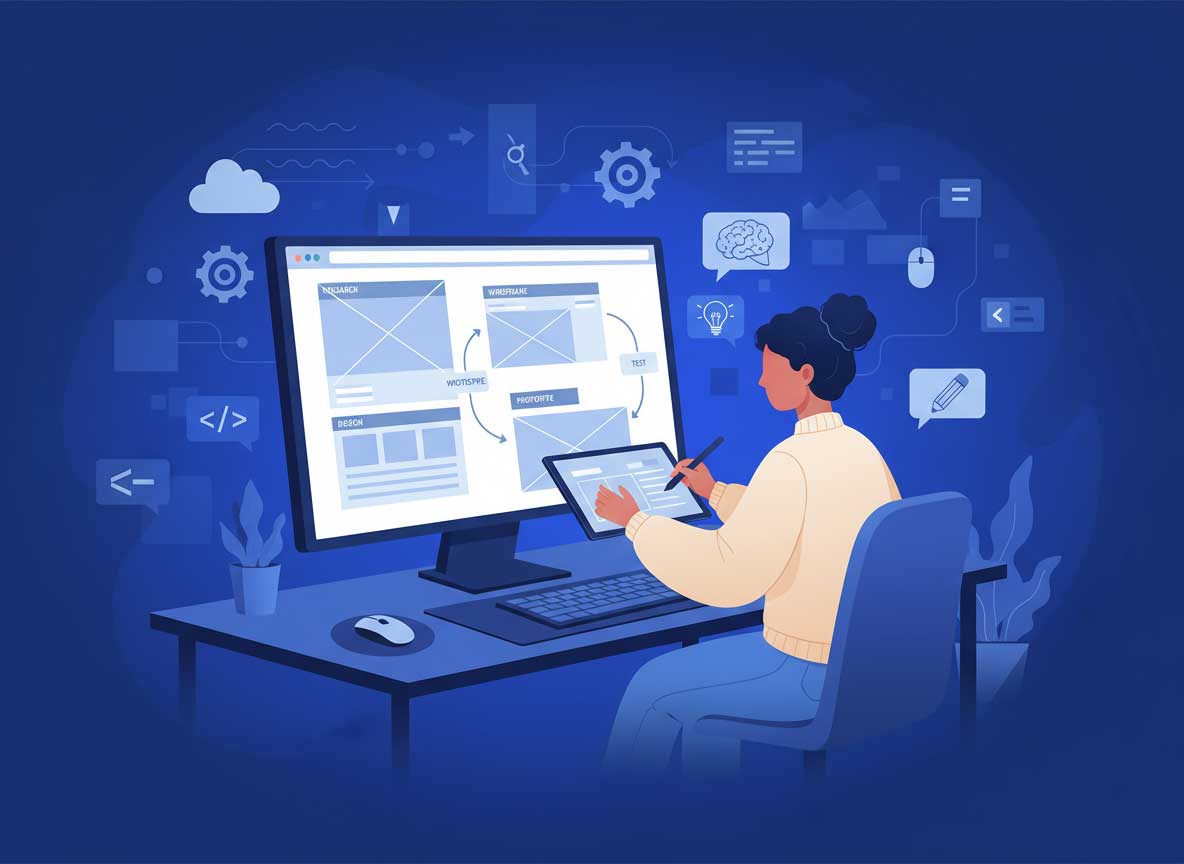
A goodworkfloweliminates unnecessary back-and-forth between teams. When designers, developers, and product owners follow a clear process (Research → Wireframes → Mockups → Prototype → Development), everyone knows when to step in and what is expected of them. This prevents the same page from being redone 10 times because the requirements were unclear from the outset.
Ensuring design quality and consistency
The workflow ensures that no crucial steps are skipped. For example, going directly from the brief to a high-fidelity mockup without a wireframe means risking wasting hours on a beautiful design... that doesn't meet user needs. Each step validates assumptions before investing more resources.
Improve communication between teams
The workflow creates a common language. When everyone understands that we are in the "discovery" phase, no one asks, "Is it ready for production?" The deliverables expected at each stage (user flows, design system, prototypes) facilitate constructive feedback.
Cost reduction and early error detection
Correcting an error in the wireframe phase costs infinitely less than in the development phase. A structured workflow allows problems to be detected early on: confusing navigation, inconsistent user journey, missing functionality.
Scalability and management of complex projects
For complex projects or distributed teams, workflow becomes vital. It allows you to manage dependencies and maintain a global view even when multiple features are being developed simultaneously.
Adaptability and iteration: evolving your product
A good workflow is not rigid. It incorporates moments for feedback, user testing, and iteration. This is what differentiates a project that stagnates from a product that evolves intelligently based on feedback from the field.
Conclusion: why a good workflow changes everything
Without a workflow, it's chaos. With a good workflow, you deliver faster, better, and with less friction. It's the invisible infrastructure that makes the difference between an amateur project and a professional one.